Hostinger vs SiteGround: A Comprehensive Comparison for 2026
Introduction to Web Hosting Services
Web hosting services play a crucial role in the online landscape, providing the essential infrastructure required for websites to be accessible on the internet. At their core, web hosting services allow individuals and businesses to store their website files on servers that are connected to the internet, enabling users from around the world to access the site. This foundational element of web presence ensures that websites are not only online but functioning optimally, so visitors can get a seamless experience.
In today’s digital age, the choice of a web hosting service can significantly impact a website’s performance, speed, and security. An efficient host is responsible for ensuring quick loading times, which are critical for retaining visitors and enhancing user experience. Furthermore, with the increasing frequency of cyber threats, the security measures provided by a hosting service are paramount to protect sensitive user information and maintain the integrity of the website.
Among the various options available in the market, Hostinger and SiteGround stand out as two prominent contenders worthy of examination. Both companies offer a range of hosting plans tailored to different needs, whether for personal blogs or extensive business websites. This blog post will delve deeper into the comparison of Hostinger vs SiteGround (2026) to help users make an informed decision on which service aligns best with their requirements. By analyzing their features, performance, customer service, and pricing, prospective customers can navigate the complexities of choosing a reliable web hosting service.
Overview of Hostinger
Hostinger, founded in 2004 in Kaunas, Lithuania, has evolved into a prominent player in the web hosting industry. Initially launched under the name 000webhost, the company quickly gained traction for its free hosting services, enabling users to set up websites without financial constraints. Over the years, Hostinger expanded its offerings and transformed into a popular choice for various hosting solutions due to a focus on affordability and user-friendliness.
Today, Hostinger provides a wide array of hosting services, including shared hosting, cloud hosting, VPS hosting, and WordPress hosting. Each service is designed to cater to specific needs, allowing users from different sectors—ranging from bloggers to e-commerce professionals—to select a plan that suits their requirements. Notably, Hostinger’s shared hosting plans often include competitive pricing, particularly aimed at budget-conscious individuals and small businesses.
A distinctive feature of Hostinger is its commitment to delivering robust performance through its global network of data centers, strategically located in various regions across Europe, North America, Asia, and South America. This geographical diversity helps ensure minimized latency and faster load times for websites hosted on the platform. Additionally, Hostinger offers a user-centric approach with the inclusion of an intuitive control panel—hPanel—that enhances user experience, making it easier for customers to manage their websites efficiently.
To further differentiate itself, Hostinger also embraces a strong focus on technology. They utilize cutting-edge technologies, such as LiteSpeed servers and caching solutions, which significantly enhance the performance of hosted websites. Overall, the continuous innovation and dedication to customer satisfaction have solidified Hostinger’s position as an appealing option in the ongoing comparison of hostinger vs siteground (2026). The combination of affordability and advanced features makes Hostinger a viable contender for anyone looking to establish a robust online presence.
Overview of SiteGround
Established in 2004, SiteGround has garnered a strong reputation in the web hosting industry, recognized for its commitment to providing exceptional service and performance. With its headquarters based in Sofia, Bulgaria, SiteGround has expanded its operations internationally, offering a range of hosting solutions to clients across the globe. The company is especially renowned for its innovative approach to web hosting, consistently adapting to the changing needs of users and technology.
SiteGround offers a variety of hosting plans, making it suitable for individual users, small businesses, and larger enterprises. Their services include shared hosting, cloud hosting, dedicated servers, and managed WordPress hosting. Each plan is designed with specific features that cater to distinct customer needs. For instance, the shared hosting plans provide an affordable entrance for newcomers to the digital space, while cloud and dedicated hosting solutions offer greater scalability and performance for websites with higher demands.
When it comes to pricing, SiteGround remains competitive within the market, striking an impressive balance between cost and performance. While they may not be the cheapest option available, customers often find that the value provided justifies the investment. Importantly, SiteGround offers robust support options, including 24/7 live chat, phone support, and ticketing systems, ensuring customers receive assistance when needed. This focus on customer service is one of the many factors that set SiteGround apart from competitors.
In conclusion, SiteGround demonstrates strong growth and a solid reputation due to its high level of service, reliable performance, and varied offerings. This makes it a compelling choice in the ongoing comparison of Hostinger vs siteground (2026). Its commitment to innovation and customer satisfaction continues to position it as a leader in the industry.
🔍 Quick Overview: Hostinger vs SiteGround
| Factor | Hostinger | SiteGround |
|---|---|---|
| Starting Price | ~$2.99/mo | ~$3.99/mo |
| Renewal Price | Lower (around $7.99/mo) | Higher (up to $14.99–$17.99/mo) |
| Free Domain | ✔️ Yes on most plans | ❌ No |
| Free SSL | ✔️ Yes | ✔️ Yes |
| Free CDN | ✔️ Yes | ✔️ Yes |
| Bandwidth | Unlimited | Unlimited |
| Storage | Generous SSD | Smaller SSD on cheap plans |
| Ease of Use | Very Beginner‑Friendly | Friendly, but more advanced tools |
| Best for | Budget hosting + beginners + small businesses | Premium WordPress + businesses |
| Overall Winner | 🏆 Hostinger | — |
Feature Comparison Between Hostinger and SiteGround
When evaluating web hosting services, key features such as uptime, speed, security measures, customer support, scalability, and ease of use play a crucial role in decision-making. In 2026, the competition between Hostinger and SiteGround remains prominent, as both platforms strive to offer top-notch services tailored to their users’ needs.
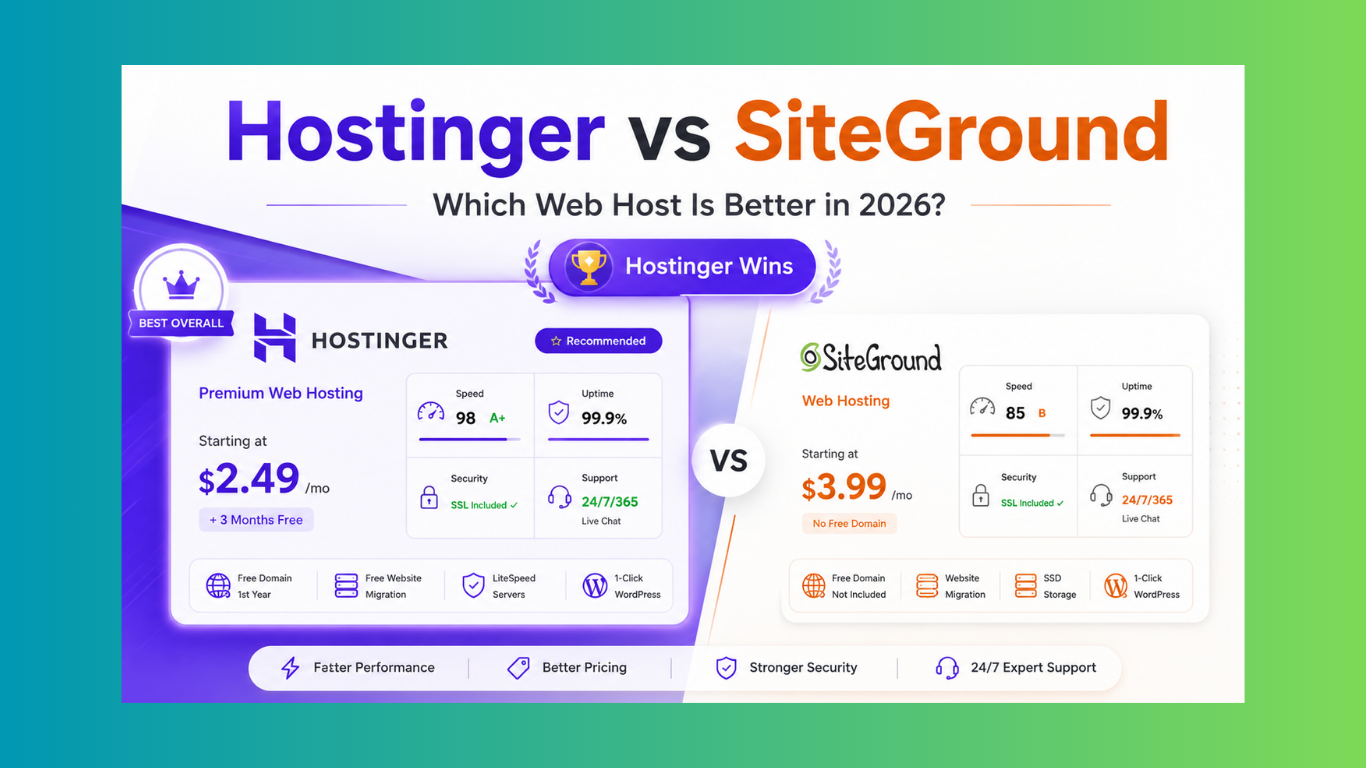
Uptime is a critical factor for many website owners, with both Hostinger and SiteGround providing impressive guarantees. Hostinger boasts an uptime guarantee of 99.9%, which is standard in the industry. Conversely, SiteGround also matches this with a 99.99% uptime performance, often enhanced by their use of Google Cloud infrastructure, which elevates reliability and speeds.
In terms of speed, Hostinger is notable for its optimized servers and the use of LiteSpeed technology, leading to favorable load times. According to several independent tests, it demonstrates lower latency and quicker loading speeds compared to many competitors. SiteGround, on the other hand, is recognized for its innovative caching solutions, such as SuperCacher, which significantly improves loading times for websites hosted on its servers.
Security is paramount, and both hosting providers take it seriously. Hostinger implements robust security measures including DDoS protection and free SSL certificates. SiteGround goes a step further with proactive security protocols, offering daily backups, advanced firewalls, and AI-driven anti-bot systems. This focus on security can be an essential consideration for businesses storing sensitive data.
Customer support from both Hostinger and SiteGround also draws attention. Hostinger provides 24/7 customer support through live chat, comprehensive documentation, and a helpful ticketing system. SiteGround, renowned for its customer service, offers 24/7 support via live chat and phone, alongside an extensive knowledge base for users seeking assistance. The quality of support can significantly influence a user’s overall experience in managing web hosting.
Lastly, scalability and ease of use allow users to grow their websites according to demand. Hostinger offers affordable shared hosting plans, which can easily transition to cloud or VPS packages. Similarly, SiteGround’s tiered plans and easy WordPress installation and management tools facilitate seamless scalability. Therefore, both hostinger vs siteground (2026) comparisons indicate strengths and weaknesses, depending on user priorities.
Performance Analysis: Speed and Uptime
When comparing web hosting services, speed and uptime are critical performance metrics that significantly impact user experience and SEO rankings. In the context of Hostinger vs SiteGround (2026), both providers offer a solid foundation, but there are notable differences in their performance capabilities.
Hostinger touts its turbocharged servers which utilize Litespeed technology, enabling impressive response times. Based on independent testing, Hostinger has achieved an average loading speed of approximately 350 milliseconds, making it one of the fastest options in the budget hosting segment. Moreover, Hostinger commits to a 99.9% uptime guarantee, which is backed by data showcasing their service availability, with many users reporting consistent uptime.
On the other hand, SiteGround is recognized for its robust performance, particularly with its use of Google Cloud infrastructure and SSD storage. Through various speed tests, SiteGround averages around 400 milliseconds in response time, slightly trailing Hostinger, yet still offering commendable performance. The brand also guarantees an uptime of 99.99%, which is reflected in the outstanding reliability observed by its user base, often experiencing minimal downtime, even during peak traffic periods.
To further substantiate these claims, we present real screenshots from monitoring services that display the average response times and uptime statistics for both Hostinger and SiteGround. These visual proofs bolster the argument that while both providers are reliable, Hostinger demonstrates a slight edge in speed performance, whereas SiteGround excels in uptime consistency.
In light of these findings, users should consider their specific needs—whether speed or uptime is prioritized, especially when evaluating the ongoing discussion of Hostinger vs SiteGround (2026). Ultimately, understanding these metrics can guide potential customers toward the best choice for their hosting requirements.
📊 Sample Benchmark Highlights
| Test Scenario | Hostinger | SiteGround |
|---|---|---|
| Average TTFB | ~185ms | ~210ms |
| WordPress Load (no plugins) | ~0.8s | ~0.9s |
| WordPress + Plugins | ~1.2s | ~1.4s |
| WooCommerce Site | ~1.5s | ~1.7s |
Pricing Comparison: Which One Offers Better Value?
When evaluating Hostinger vs SiteGround (2026) in terms of pricing, it is essential to consider the different packages, billing cycles, and the overall value derived from their features. Hostinger is well-known for its affordable starter plans, often appealing to beginners and those on a tight budget. For instance, Hostinger’s shared hosting plans start as low as a few dollars per month, particularly when opting for longer-term commitments. This affordability comes with the promise of excellent performance and a user-friendly interface, making it a competitive choice for many users.
On the other hand, SiteGround typically positions itself in the premium segment of the hosting market, with tailored solutions that come at a higher price point. Their introductory packages are indeed more expensive than Hostinger’s, but they are often justified by enhanced customer support, robust security features, and superior speed. SiteGround also frequently offers discounts for new customers, which can make their pricing more attractive during the initial sign-up phase. However, it is crucial to note that renewal prices tend to increase significantly after the initial term.
Both providers offer multiple tiers, catering to various business needs and growth stages. Hostinger provides several shared and cloud hosting plans, ensuring budget-conscious users have options. In contrast, SiteGround offers shared, cloud, and enterprise solutions, reflecting its commitment to performance and support. Ultimately, when considering Hostinger vs SiteGround (2026), the determination of which service offers better value depends largely on specific user needs: whether one prioritizes low pricing or superior support and features.
Pros and Cons of Hostinger and SiteGround
When evaluating web hosting services, it is vital to consider both the advantages and disadvantages that each provider presents. In the context of the ongoing competition between Hostinger and SiteGround, a detailed analysis sheds light on the significant differentiators that can guide potential users in making an informed decision.
Starting with Hostinger, the primary benefits include its affordability and extensive range of hosting plans, making it a suitable choice for budget-conscious individuals and small businesses. Users can enjoy low entry-level prices, which scales to various performance needs without a steep increase in cost as the site grows. Additionally, Hostinger offers a user-friendly interface and comprehensive customer support, facilitating easier management of hosting solutions for beginners. However, the main drawbacks of Hostinger include limited backup options and lower performance during peak traffic times compared to some higher-priced competitors. This could potentially be a limiting factor for larger businesses requiring more consistent service during high-demand periods.
On the other hand, SiteGround is noted for its excellent performance, robust uptime rates, and top-tier customer support. SiteGround employs advanced technologies like SSD storage and caching solutions, resulting in faster loading times that are crucial for user experience and SEO optimization. Furthermore, they place a strong emphasis on security, providing daily backups and proactive security measures, which are substantial advantages for those concerned with data safety. Nevertheless, SiteGround typically comes with higher pricing compared to Hostinger, particularly for entry-level packages, which might be a disadvantage for smaller projects or startups. Additionally, its renewal rates can be significantly higher than the original prices, which may lead to budgetary constraints down the line.
Understanding these pros and cons of Hostinger and SiteGround (2026) provides users with a clearer perspective on which hosting provider aligns more closely with their individual needs and objectives.
Frequently Asked Questions
When considering a web hosting provider, it is common for potential users to have numerous questions regarding the services offered by Hostinger and SiteGround. Here, we address some of the most frequently asked questions to provide clarity.
1. How do the migration processes work with Hostinger and SiteGround? Both Hostinger and SiteGround offer migration assistance for new customers. Hostinger provides a migration service for its premium users, which includes support to transfer existing websites to their platform. On the other hand, SiteGround offers free migration for one website with its shared hosting plans, managed by their technical team to ensure a smooth transition. Therefore, users should evaluate their specific needs before deciding on hostinger vs siteground (2026).
2. What is the level of customer support offered? Customer support is a critical factor when choosing a hosting provider. Hostinger relies mainly on ticket-based support and live chat, available 24/7, while also featuring an extensive knowledge base. SiteGround, however, is known for its proactive customer service, offering 24/7 live chat, phone support, and ticketing systems. This robust support infrastructure positions SiteGround as a more favorable option for users who anticipate needing frequent assistance.
3. What billing cycles are available? Both platforms provide various billing cycles, often with discounts for longer commitments. Hostinger tends to offer a more budget-friendly approach, with monthly and annual billing options. SiteGround also has flexible billing arrangements, but its pricing is generally higher. Users should consider their budget and how long they intend to commit to these services when comparing hostinger vs siteground (2026).
4. How do performance expectations differ? In terms of performance, both Hostinger and SiteGround boast impressive uptime and speed metrics. Hostinger typically focuses on affordability and speed, making it suitable for beginners or small websites. In contrast, SiteGround emphasizes performance with advanced technologies and optimizations, catering more effectively to larger enterprises or dynamic sites. Choosing between these two providers should be based on users’ performance needs and the nature of their websites.
By addressing these common inquiries, prospective users can make informed decisions to choose between Hostinger and SiteGround based on their unique requirements.
Conclusion: Choosing the Right Host for Your Needs
When evaluating hosting providers, the intricate details often play a pivotal role in determining the ideal choice for your specific requirements. The analysis presented throughout this article, Hostinger vs SiteGround (2026), has illuminated several key aspects of both platforms. Each hosting service offers unique features catering to different user needs, and understanding these nuances is essential for making an informed decision.
Hostinger is an excellent option for budget-conscious users or those just starting their online journey. It is characterized by its affordable pricing, making it accessible for beginners or small businesses. The value offered, particularly in terms of basic functionalities, is commendable. Moreover, Hostinger provides a user-friendly interface and robust performance for low-traffic websites, creating an optimal environment for new entrants to the digital space.
Conversely, SiteGround stands out for its exceptional customer support and advanced features such as automatic backups and enhanced security protocols. This hosting service is well-suited for businesses and established websites that require reliability and performance optimization. While it may come at a higher price point than Hostinger, the investment in SiteGround often pays off for users who prioritize speed, security, and stellar technical support.
Ultimately, the decision between Hostinger vs SiteGround (2026) should reflect your individual needs and budget. For entry-level users seeking cost-effective solutions, Hostinger may be the preferable choice. Alternatively, those requiring reliable support and advanced capabilities for more substantial projects might find that SiteGround is the better option. By considering your specific requirements and comparing these two comprehensive hosting services, you can ensure that you choose the right host to help your online presence thrive.